

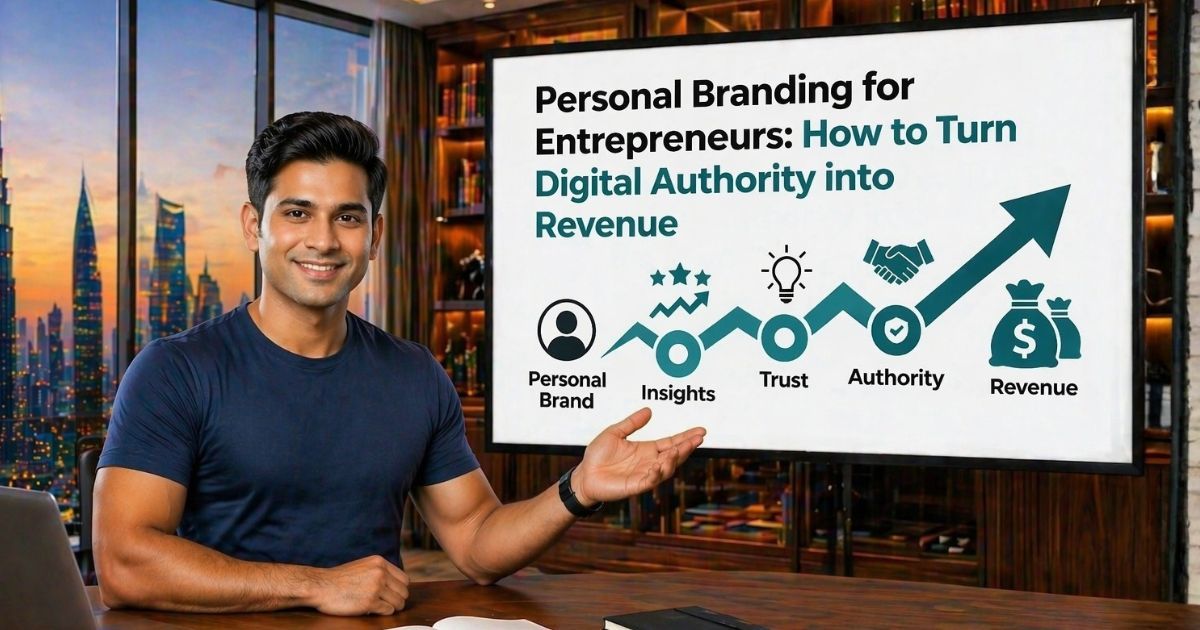
Let’s get straight to the point. When we talk about personal branding for entrepreneurs, the conversation often focuses on vanity metrics like follower counts and likes. But for a real business owner, a brand is useless if it does not drive revenue.
Today, people buy from people they trust. If your target audience does not know who you are, what you stand for, or why your business exists, you are leaving money on the table. Building a personal brand is no longer just for influencers; it is a core business strategy for founders who want to scale their operations, attract premium clients, and dominate their niche.
This guide will show you exactly how to build a result-oriented founder personal brand strategy that generates high-quality leads and establishes real authority in your industry.
Why Personal Branding for Entrepreneurs is a Real Revenue Driver
Many founders think that their company’s marketing is enough. They spend thousands on performance ads but ignore their own digital presence. Here is why that is a mistake.
1. People Buy from People, Not Logos Consumers and B2B clients are naturally skeptical of corporate messaging. They want to know the human behind the brand. When you practice executive personal branding, you put a face to the business. This builds instant trust. If a prospect trusts you, they are much more likely to trust your company.
2. Attracting Premium Talent and Investor Trust A strong personal brand does not just attract customers. It attracts top-tier talent who want to work for a visionary leader. Furthermore, building trust with investors through content is a proven strategy. Investors look at the founder’s digital footprint to gauge their market understanding and leadership abilities before writing a check.
3. Personal Brand vs Company Brand: The Quick Difference
- Company Brand: Focuses on the product, the service, features, and corporate values. It is professional but often formal.
- Personal Brand: Focuses on your journey, your failures, your insights, and your unique perspective. It is relatable and highly engaging.
You need both. The company brand handles the transaction; the personal brand handles the relationship.
The Founder’s 3-Step Strategy to Build Digital Authority
You are busy. You do not have time to spend four hours a day scrolling on social media. Building digital authority for CEOs requires a systematic, time-efficient approach.
Step 1: Pinpoint Your Core Narrative
Before you write a single word, you need to know what you want to be known for. Do not try to talk about everything. Pick 3 to 4 core content pillars.
For example, if you run a digital marketing agency, your pillars could be:
- Advanced SEO strategies
- Agency growth and team building
- Lessons learned from failed campaigns
- Your daily routine and discipline
Stick to these topics. This builds topical authority around your name.
Step 2: Choose High-Impact Platforms
Do not spread yourself thin across every social media platform. Go where your audience is. For B2B personal branding on LinkedIn, the ROI is massive. LinkedIn is currently the best platform for founders to share written insights, company milestones, and industry opinions.
If your audience is younger or highly visual, Instagram or X (Twitter) might be your secondary platform. Pick one primary channel and master it before moving to the next.
Step 3: Create a Sustainable Content System
Consistency is the only ranking factor that matters on social media algorithms. Create a batching system. Sit down for two hours every Sunday and write your posts for the entire week. Use scheduling tools to automate the posting process. This keeps you visible without interrupting your daily business operations.
Leveraging Short-Form Content for Business Owners
Written posts are great, but video is where you build a deep connection. Short-form content for business owners (like Instagram Reels and YouTube Shorts) has the highest organic reach right now.
Why Short-Form Video Works:
- Attention Spans are Short: A 60-second video delivers a quick, high-impact message.
- Trust Building: Hearing your voice and seeing your body language builds familiarity faster than text.
- Algorithm Favoritism: Platforms are actively pushing short vertical videos to new audiences.
Simple Framework for a 60-Second Video:
- The Hook (0-3 seconds): Call out your target audience’s pain point. (e.g., “Stop wasting money on bad Facebook Ads. Do this instead.”)
- The Value (3-45 seconds): Give 2 or 3 actionable, rapid-fire tips.
- The Call to Action (45-60 seconds): Tell them what to do next. (e.g., “Save this video” or “Link in my bio to work with my team.”)
Overcoming camera shyness for founders takes practice. Start by recording videos just for yourself. Once you get comfortable speaking clearly, start publishing. Remember, people prefer authentic and slightly unpolished videos over heavily scripted corporate ads.
Overcoming the Cringe Factor: How to Post Like a Professional
Many entrepreneurs hesitate to build a personal brand because they do not want to sound like a “guru” or look desperate for attention. You can avoid this completely by focusing on value.
Focus on Education, Not Bragging If your posts are just “Look at my new car” or “Look at my award,” people will tune out. Instead, practice CEO thought leadership content. Share how you solved a specific problem for a client. Share a mistake you made last year and how it cost you money. Vulnerability paired with a business lesson is highly engaging.
Document, Don’t Create You do not need to invent new topics every day. Just document what you are already doing. Did you have a great strategy call with your team? Write a post about the main takeaway. Did you lose a big client? Write about the lesson learned. This is the most authentic form of personal branding for entrepreneurs.
Scaling Your Presence: Hiring a Consultant
Eventually, your business will grow to a point where you cannot manage your content alone. This is where you look into personal branding consultant benefits.
Outsourcing Founder Personal Branding A good ghostwriter or personal branding agency will save you dozens of hours a month. They will interview you, extract your ideas, and turn them into highly engaging content in your exact tone of voice.
When looking for help, ensure they understand your industry. You want someone who knows how to write for business leaders, not just someone who makes viral dance videos. They should focus on lead generation through personal brand strategies, not just getting you more “likes.”
[Internal Link Suggestion: Link to your service page or contact page here, e.g., “If you need help scaling your digital presence, check out our consulting services.”]
How to Measure Your Personal Brand’s Success
How do you know if your personal brand strategy is actually working? You need to track the right metrics. Personal brand monetization for entrepreneurs is measured by pipeline growth, not follower count.
Track These Key Metrics:
- Inbound Direct Messages (DMs): Are potential clients messaging you to ask about your services?
- Profile Views and Search Appearances: Is your LinkedIn profile getting viewed by your target demographic?
- Speaking Opportunities: Are you being invited to podcasts, webinars, or industry events?
- Sales Call Conversion Rate: Are prospects already “sold” on you before they even get on the discovery call?
If these numbers are going up, your personal branding for entrepreneurs strategy is highly successful.
Frequently Asked Questions (FAQs)
1. I am too busy to create content. How much time does personal branding actually take? If you use a proper content system, it should take no more than 2 to 3 hours a week. By batch-creating written content and recording short videos in one session, you can schedule everything in advance. Alternatively, hiring an agency can reduce your time investment to just a 30-minute interview call per week.
2. How do I overcome camera shyness and imposter syndrome? Action cures fear. Start small. You do not need to be a professional speaker to provide value. Speak to the camera exactly how you would speak to a client sitting across from your desk. The more you practice, the more natural it becomes.
3. Can my personal brand directly increase my company’s sales? Absolutely. A strong personal brand acts as a 24/7 sales engine. When you educate your audience and solve their problems publicly, you become the logical choice when they are ready to buy. It warms up leads before they even visit your company website.
4. Should I keep my personal life completely separate from my professional brand? You do not need to share everything, but sharing 10-20% of your personal life (like your fitness routine, hobbies, or family values) humanizes you. People connect with shared interests just as much as they connect with business expertise.
5. How long does it take to see tangible ROI from personal branding? Personal branding is a marathon, not a sprint. Typically, it takes 3 to 6 months of consistent, high-quality posting to start seeing a steady stream of inbound leads and industry recognition.
6. Is it better to focus on text posts on LinkedIn or short-form video on Instagram? It depends entirely on your target audience. If you sell B2B services, prioritize LinkedIn text and carousel posts. If you are in real estate, fitness, or B2C e-commerce, short-form video on Instagram will likely yield faster results.